
26 Mar MBBS in China Eligibility Criteria for Pakistani Students
MBBS in China eligibility criteria for Pakistani students are some of the most important things to understand before applying for medical studies abroad. Low tuition costs, globally recognized degrees, and straightforward entry standards are key to this trend. The requirements for getting into medical school in China are much simpler than in many other countries. This makes it easier for students to apply and gain admission into well-known medical schools. Before applying, it is important to understand the complete requirements. You can read our detailed guide on MBBS in China for Pakistani Students for full information.
Basic Eligibility Criteria for MBBS in China
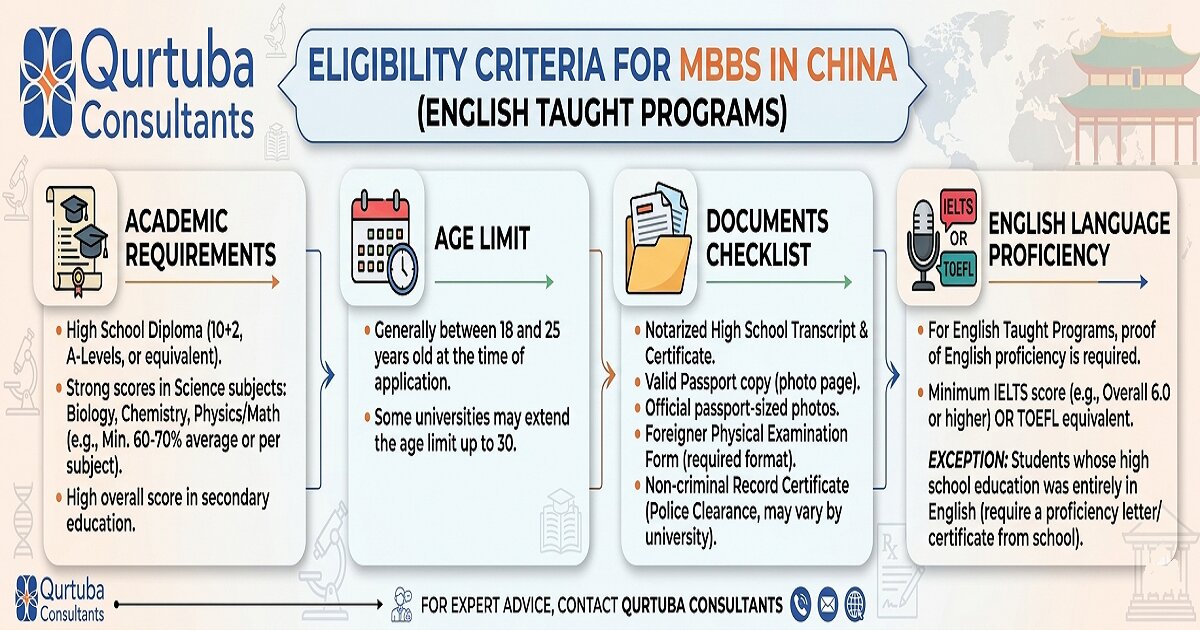
Academic Requirements:
It is simple for students to gain admission into Chinese colleges to study MBBS. Therefore, to enrol in the MBBS course, students need to meet all the requirements. The total marks from different universities may be different, though.
- The students have passed the 10+2 test.
- Students have a science background (pre-medical).
- Biology, chemistry, and physics should be among the subjects.
- Candidates must not be Chinese citizens and have MBBS seats in China.
- All of China’s candidates respect the norms and regulations of the international quota.
- Each medical college has its age limit guidelines that students adhere to.
Minimum Marks Requirement:
- To pass the higher secondary exam, applicants must get at least 60% of the marks.
- But some colleges will take lower grades.
Age Limit for MBBS in China:
- The students should be at least 17 years old.
- Candidates can be no older than 26 years old.
- The students need to obtain a student visa that is valid for 18 months.
According to the new criteria, you must pass the NEET test to be able to study MBBS abroad.
English Language Requirements:
Is IELTS Required for MBBS in China?
You usually don’t need to take IELTS or TOEFL to apply to the medicine programme (MBBS) in China. But other universities, like Tianjin Medical University, Zhejiang University, Dalian University, Fudan University, Zhengzhou University, and Tongji University, only allow international students to enter the MBBS program if they have passed IELTS or TOEFL.
Medical Fitness Requirements:
To get into an MBBS school in China and get an X1 student visa, you must be medically healthy. Foreigners who want to study in China must all pass a medical exam. You can have the physical medical exam done in your native country or when you get to China. We usually tell students to take the medical exam in China because occasionally the medical tests they take in their home country aren’t approved, whether they make a mistake or don’t follow the right format. In such a case, students have to do the medical test again in China. You may need to take the medical exam in your country before applying to some colleges or getting grants.
– In English or Chinese
– Must have your picture on it
– Must be in a public hospital
– Please remember to upload all of the test results from the lab:
– Blood testing
– Chest x-ray
– Urine test
– ECG
Documents Required for MBBS in China Admission:
Students need to send in many papers to get into MBBS. It is necessary to submit all of the appropriate documentation at the time of admission.
- The students must send in their 10th and 12th-grade mark sheets so that the candidates can be judged on their eligibility.
- You need to show a copy of your birth certificate.
- Getting your birth certificate notarized is very significant.
- The students need to turn in their HIV test results to show that they are healthy.
- Aside from this requirement, the candidates also send in 2 to 3 passport-sized photos.
- You must know these details before you apply to Chinese institutions for MBBs.
- When they go to China, the MBBS applicants have to show the invitation letter that their universities issued them.
- Everyone who wants to transfer must turn in their transfer certificate.
- They won’t have any problems getting in if they turn this in.
- You also need a medical certificate to travel to China.
- You can’t get into medical school without a medical certificate.
- It is required by university rules that you have police verification certificates.
- You need a no-criminal certificate to clear your criminal record.
- When the candidates proceed to apply for MBBS admission, they must submit their confirmation or invitation letter.
- The embassy must provide the students with permission to enroll in medical studies.
- Students really need to have a valid passport.
- The candidates can’t continue studying for their MBBS in China without a passport.
- If the students don’t do what they say, their application to study MBBs will be denied.
Therefore, it has been shown that the students need to turn in all of the paperwork. You must have these papers in order to be considered for admission to the MBBS programmed. The list of documents will be the same for both Pakistani and overseas students. It will be beneficial for Pakistani students to enroll in an MBBS programmed in China.
Eligibility Criteria for MOE Listed Universities:
- The Central Government of China runs the universities on the MOE list. WHO approved medical universities in China, PMC recognized universities list, WFME, WCAME, and ECFMG have approved these universities.
- The MBBS degree takes six years to complete. This includes five years of education and one year of internship.
- All across the world, people accept degrees from universities that are on the MOE list. Graduates can take the USMLE (America), PLAB (England), AMC (Australia), NMC (India), BMDC (Bangladesh), SLMC (Sri-Lanka), and other tests.
- One excellent thing about going to a MOE-listed university is that they teach anatomy, biochemistry, and physiology in the first year of the MBBS program.
- Only MOE-listed universities in China are allowed to teach the MBBS (Bachelor of Medicine and Surgery) programme in English by the Ministry of Education of China (MOE China).
- You don’t have to pass HSK-3 or HSK-4 in your first year. The Ministry of Education (MOE) has already granted permission to schools in China to teach MBBS in English.
- Only universities on the MOE China List can write “Clinical Medicine MBBS in English” on their admission letters.
- The MOE-listed universities are some of the oldest and most complete in China. Most are part of the 211 or 985 Chinese projects, which are well-known and highly ranked.
- MOE-listed colleges demand significantly more credit hours than their unlisted counterparts.
- The MOE-listed universities’ fee packages are very high since they make it simpler for international students to get an excellent education in a language they can understand.
Eligibility Criteria for Non-MOE Universities:
- The WHO and PMC also approve MOE non-listed universities, which the provincial government of China manages.
- It takes six years to obtain an MBBS degree: one year of Chinese, four years of MBBS, and one year of internship. The student will get their degree after five years.
- Students can only study Chinese for their first year at universities that aren’t on the list. Before students can start studying medicine for four years and subsequently graduate, they have to pass the HSK-3/HSK-4 (Chinese language test).
- If you do not pass Chinese, you will forfeit an academic year and be required to cover the expenses for the initial year. Students must pass HSK-5 to graduate. Students can only obtain their degree if they pass HSK-5.
- Programs at universities that aren’t listed are available in both Chinese and English.
- Colleges and universities that aren’t on the list can’t say “English Medium” on their acceptance and visa letters. The Ministry has told these schools that they can only teach in Chinese.
Can Students with Low Marks Apply?
Yes, students with lower scores can apply for MBBS in China. This is especially true for lower-tier or private medical schools that often accept candidates with 60% or lower in science subjects, including physics, chemistry, and biology. But the best MOE-listed (Ministry of Education) colleges want students to get at least 60% to 70% on the FSc/A-Levels.
Common Mistakes Students Make:
When earning an MBBS in China, people often make the error of not checking to see if the school is on the MOE list, simply looking at the school’s fees, and not knowing how crucial it is to be proficient in HSK (Chinese language) for clinical rotations. Students often don’t know how hard tests require studying for licensure exams like PLAB, USMLE, and NLE and investigating the backgrounds of people who work in hospitals.
Things You Should Not Do:
When choosing a university, you could make mistakes by choosing one that isn’t on the Ministry of Education’s (MOE) list or by falling for fake agents’ “guaranteed” admission frauds. Ensure that the medical authorities in your nation, such as PMDC or NMC, recognise the university.
Language skills matter: Learning Chinese (HSK) is essential, even though the lessons are in English. You need it to talk to patients during internships.
Some people think that Chinese medical exams are simple to pass by cramming at the last minute, but this is not true. They are hard-working and well-organized.
Misunderstanding the Curriculum: Some schools may not have adequate clinical exposure in English, which makes it challenging for students to learn while they are in the hospital.
Not Getting Ready for Licensing: Many students neglect to study for licensing tests (NLE, USMLE, PLAB) while they’re in school, which is highly vital for their future jobs. Failing to examine the legitimacy of paperwork like JW202 forms and police clearance certificates and to account for hidden costs like accommodation, insurance, and textbooks are all money and management mistakes.
Not Meeting Academic Standards: A lot of Pakistani students make the mistake of not getting the 60% they need in FSc (pre-medical) or the 50% they require in MDCAT.
MBBS in China Admission Process Overview:
If you have someone to help you, it’s not difficult to apply for MBBS in China. First, choose a medical school based on your GPA and budget. Thereafter, you send in your application and get your papers ready.
The next step is to secure a student visa and make plans to leave as soon as you get your acceptance letter. Even if it’s not hard, many students still make little blunders that could slow things down. For step-by-step guidance, check our MBBS in China admission process guide.
Why Eligibility Matters for MBBS in China:
Many students don’t think about eligibility at first, but it’s a really vital part of the whole process.
It makes it more or less probable that you will get in.
Colleges don’t simply look at your GPA; they also look at other things about you. Your chances of getting into a reputable school go up a lot if you meet the qualifying standards.
It’s crucial to obtain a visa.
To get your student visa, you need to have the right papers and meet the conditions. Things could get worse if you make even slight mistakes or omit to incorporate important information.
It will be important for your future job.
Many students don’t know the significance of this subject. If your university and eligibility don’t meet the requirements, getting a licence in Pakistan or elsewhere may be challenging.
Apply for MBBS in China. Through Qurtuba Consultants:
To avoid misunderstanding and make things run more easily, it’s best to apply through a well-known consultant like Qurtuba Consultants.
- They have been conducting this job since 2001 and have helped thousands of Chinese students get their medical careers off the ground.
- We have helped more than 4,500 students get into Chinese schools.
- I received good advice on which university to attend and full assistance with the visa and application process.
👉 Go to Qurtuba Consultants to find out more and start your application.
Conclusion:
Understanding the MBBS in China eligibility criteria for Pakistani students helps you avoid mistakes and increases your chances of admission. Pakistani students might think about going to China to do their MBBS. This is a wonderful option if you want a high-quality education that doesn’t cost too much. First, you need to check that you meet the fundamental requirements.
Once you know if you qualify, the remainder of the process is much easier and goes more smoothly.
Our guide for Pakistani students will tell you everything you need to know about the expenses, universities, and how to get into MBBS in China. If you are exploring more options, you can also visit our Study in China services page for complete guidance.
Frequently Asked Questions:
What is the minimum percentage for MBBS in China?
Most colleges and universities want students to get at least 60% to 70% on their FSC (pre-medical) examinations. Some colleges are more open-minded and may accept students even if their grades aren’t outstanding.
Can I apply with 50% marks?
You can still apply if you got a 50%, but you won’t have as many choices. Getting the right advice is very crucial so you can choose the best colleges.
Is IELTS required for MBBS in China?
You don’t generally require the IELTS. A letter from your old school saying that you speak English well will work for many schools instead.
What is the age limit for MBBS in China?
You have to be at least 17 years old. Most colleges and universities want students who are younger than 25.
What documents are required for MBBS in China?
You need to bring your passport, pictures, diplomas, and a note saying you are okay. Some colleges and schools may also need more documents.
No Comments